
Discover the TIA Openness API from Siemens, a powerful interface for automating, standardizing, and optimizing engineering tasks in the TIA Portal environment. This article explores its benefits, integration possibilities with languages like C#/.NET, limitations, and best practices for unlocking unparalleled productivity and reliability in the Operational Technology (OT) domain.
Introduction: The Era of Automation Beyond Control
In the fast-paced world of industrial automation, engineers are constantly seeking ways to improve efficiency, reduce errors, and accelerate project cycles.
While programmable logic controllers (PLCs) and human-machine interfaces (HMIs) have revolutionized production, the engineering of these systems often remains a manual, repetitive, and time-consuming task.
This is where the TIA Openness API from Siemens comes in, a true key to unlocking a new level of automation.
Imagine being able to generate entire projects, modify code blocks, or configure thousands of tags in just a few seconds, all programmatically.
TIA Openness turns this vision into reality, offering developers and integrators the tools needed to interact directly with the TIA Portal environment. No more endless clicking and tedious copying and pasting; welcome to engineering at the speed of light!
What is TIA Openness, Concretely?
TIA Openness is a programming interface that allows external applications to communicate and interact with Siemens TIA Portal.
In other words, it is a gateway that opens access to the internal functions of Siemens' most popular engineering software.
Through it, third-party programs can read, modify, create, and delete elements within a TIA Portal project, such as controllers (PLCs), HMIs, variables, program blocks, and even network topologies.
Developed on the basis of Microsoft's .NET platform, TIA Openness primarily addresses developers proficient in languages like C#.
It does not merely automate simple tasks; it enables deep and complex integration, transforming TIA Portal into a highly programmable platform.
From creating custom libraries to integrating with Product Lifecycle Management (PLM) systems or version control systems, the possibilities are vast for those who know how to leverage them.
The Undeniable Advantages of TIA Openness
One of the most evident advantages of TIA Openness is the significant increase in productivity.
Repetitive and time-consuming tasks, such as creating numerous similar objects or making mass modifications, can be automated.
This liberates engineers for higher-value tasks, accelerating project delivery and reducing engineering costs. No more pain from manual duplication tasks!
Next, Openness fosters increased standardization and quality.
By automating code and configuration generation, perfect consistency between projects is ensured.
Less manual intervention means fewer human errors, resulting in more reliable systems that are easier to maintain.
Compliance with internal and external standards becomes an automated process, no longer a manual check prone to oversight.
Finally, this API allows for unprecedented flexibility and innovation.
Companies can develop custom tools that specifically meet their needs, integrating TIA Portal into their existing software ecosystem.
This opens the door to entirely new engineering workflows, from model-based code generation to continuous integration and deployment (CI/CD) in OT, a true revolution for Industry 4.0.
The Revolutionary Possibilities: Unleashing Your Creativity
The capabilities of TIA Openness extend far beyond simple automation.
Imagine generating entire TIA Portal projects from configuration databases, ideal for modular machines or highly configurable factories.
You can create function blocks, data blocks, HMI variables, and even hardware configurations without ever manually opening TIA Portal.
This is a boon for original equipment manufacturers (OEMs) who deploy many similar machines.
Beyond generation, Openness enables mass modification and updating.
Need to change the name of a thousand tags or adjust parameters in a series of function blocks?
A script can do it in the blink of an eye.
This capability is invaluable for maintaining and evolving existing projects.
Moreover, it facilitates the extraction of information for automatic documentation or integration with code analysis tools, making code tracing and understanding much easier.
The API also paves the way for deep integration with other systems.
You can synchronize information between TIA Portal and an ERP/MES system, a version control system (like Git) for PLC code, or even simulation tools.
This interoperability is crucial for a holistic and connected engineering approach, where data flows freely between different layers of the enterprise.
For more information on specific features, don't hesitate to visit Siemens' official page on TIA Openness: TIA Portal Openness.
Challenges and Restrictions to Consider
Despite its numerous advantages, TIA Openness presents challenges.
The first is the learning curve.
Developing with Openness requires a good understanding of TIA Portal concepts as well as programming skills (primarily C# and the .NET framework).
The documentation, while available, can be dense and requires a certain investment to master.
It's not a 'plug-and-play' tool, but a full-fledged development environment.
Another major constraint is the dependence on TIA Portal versions.
Each version of TIA Portal (e.g., V16, V17, V18) requires a specific version of the TIA Openness API.
This means your Openness applications will need to be updated and potentially recompiled when migrating to a new version of TIA Portal, which can represent a significant adaptation effort.
Finally, although powerful, there are inherent restrictions to the API.
Not all TIA Portal features are exposed via Openness, and certain operations may be slower than if they were performed manually.
It is crucial to understand the API's limits to avoid frustrations or inefficient developments.
Performance may also vary depending on the size and complexity of the TIA Portal project being manipulated, sometimes requiring optimizations on the application side.
It's precisely to overcome these technological barriers that innovative solutions like T-IA Connect have emerged.
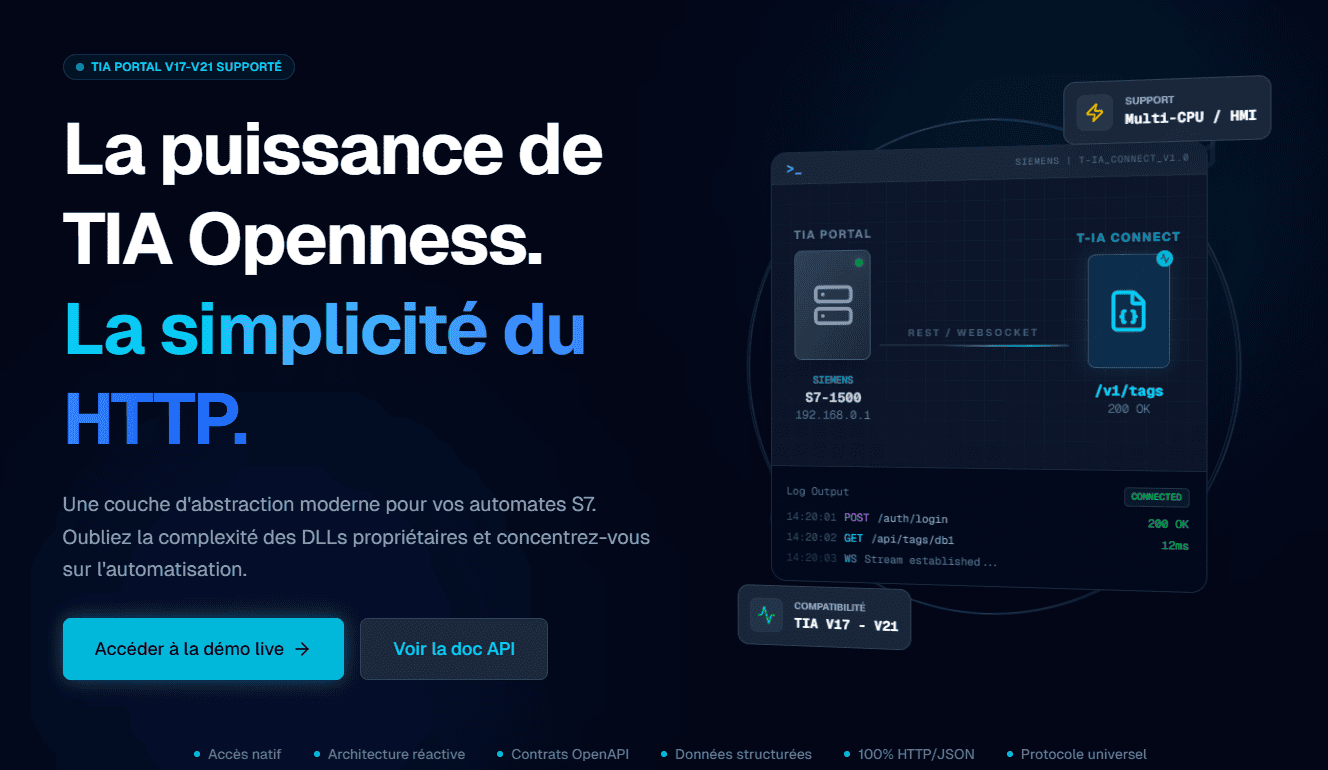
By transforming the complex TIA Openness libraries into a universal REST API, these tools allow automation professionals to drive TIA Portal without writing a single line of C#, opening the way to using modern web languages and, above all, Artificial Intelligence.
Concrete ApplicationExamples: Where TIA Openness Shines
A typical use case is the automatic generation of projects for configurable machines.
A client selects options in a web configurator, and a TIA Openness application generates the complete TIA Portal project, with the right hardware configuration, program blocks, and associated variables.
This ensures rapid and error-free delivery for each new order, regardless of the level of customization.
Another powerful example is the centralized update of enterprise standards.
Imagine a new version of a standard function block that needs to be deployed across hundreds of existing projects.
Instead of opening each project one by one, a TIA Openness application can traverse all projects, update the relevant block, and recompile the whole.
This capability transforms the management of libraries and standards, ensuring all systems are up-to-date with the best practices.
For technical resources and examples, Siemens' support portal is a treasure trove of information: Siemens Industry Online Support.
How to Get Started with TIA Openness?
To start developing with TIA Openness, you will need several prerequisites.
First, a functional installation of TIA Portal on your machine.
Then, an Integrated Development Environment (IDE) like Microsoft Visual Studio, which supports C# and the .NET framework.
Finally, you will need to install the TIA Openness SDK (Software Development Kit) corresponding to your TIA Portal version, usually available via the TIA Portal installation or on Siemens' support portal.
The SDK contains the necessary libraries and examples to start coding.
Initial learning will involve understanding the object structure of TIA Portal exposed by the API.
Each element (project, device, CPU, block, tag) is represented by an object with its properties and methods.
It is recommended to start with simple scripts, such as reading project information, before moving on to more complex creation or modification operations.
Perseverance and exploration of the documentation are your best allies for mastering this powerful tool.
AI and TIA Openness: Towards Generative Engineering
The natural evolution of TIA Openness now passes through the integration of Artificial Intelligence.
If Openness is the 'armed arm' that executes commands in TIA Portal, AI becomes its 'brain'.
By coupling a AI Connector for Siemens with the Openness API, it becomes possible to automatically generate complex SCL code blocks, document thousands of variables, or analyze hardware architectures via models like GPT-4 or Claude 3.5.
This synergy between Siemens' openness and the power of LLMs defines what we now call Generative Engineering, where design time is divided by ten.
Conclusion: The Future of Engineering in Automation
The TIA Openness API from Siemens is more than just a tool; it's a catalyst for innovation in automation engineering.
It offers an unprecedented lever for automating tasks, standardizing processes, reducing errors, and integrating TIA Portal into larger software ecosystems.
Although it requires an investment in skills, the returns in terms of productivity and quality are considerable.
For companies and engineers eager to push the limits of automation and fully embrace Industry 4.0 principles, TIA Openness is an essential skill to acquire.
It's the gateway to more intelligent, faster, and more reliable engineering, opening the way to a new era of creativity and efficiency in the world of Operational Technology.
For companies and engineers looking to take this step without suffering the learning curve of the Siemens SDK, discovering a solution like T-IA Connect is the best way to transform TIA Portal into a programmable, connected, and AI-augmented resource today.